


March 17, 2026
Zero Trust Security for Utah Small Businesses: A Practical Starting Point
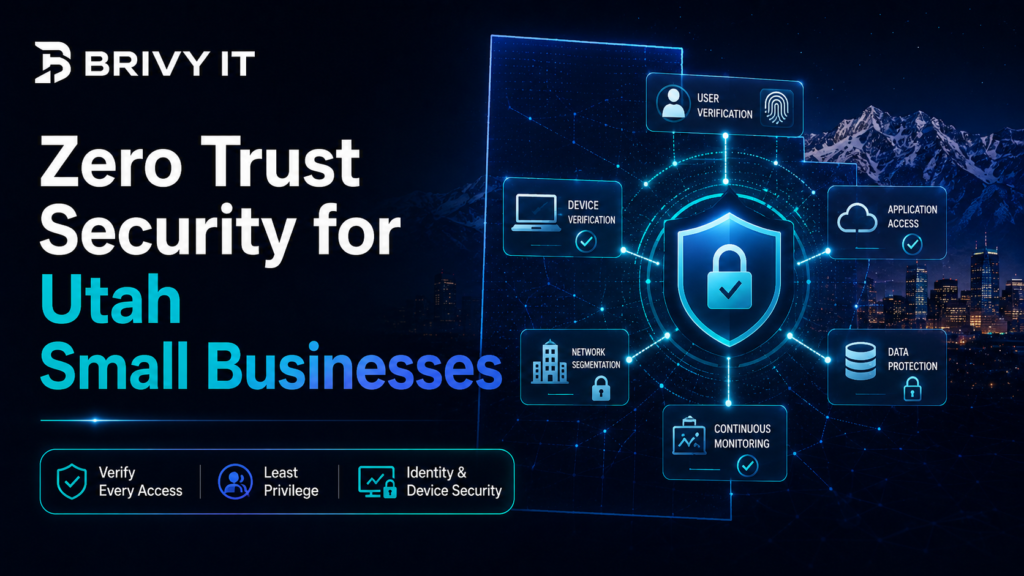
Zero Trust Security for Utah Small Businesses: A Practical Starting Point
Zero Trust used to be an enterprise-only concept. Now it's the most effective security model for businesses of any size — and Utah companies are catching on fast.
- ✓Zero Trust means no user, device, or application is automatically trusted — every access request is verified, every time
- ✓Utah small businesses are prime targets because attackers assume smaller companies have weaker defenses
- ✓You can start implementing Zero Trust today with MFA, least-privilege access, network segmentation, and conditional access policies in Microsoft 365
- ✓Brivy IT builds Zero Trust security programs for Utah businesses using Sophos endpoint protection, Microsoft 365 conditional access, and network segmentation
Most small business networks still operate on a trust-by-default model. Once someone logs in or connects to the office Wi-Fi, they can access everything — file shares, accounting software, customer databases, email archives. The assumption is that if you’re inside the network, you belong there.
That assumption is exactly what attackers exploit. A single stolen password, one compromised laptop, or a successful phishing email gets an attacker past the front door. From there, the entire network is open.
Zero Trust flips this model. Instead of trusting everything inside your perimeter, Zero Trust treats every access request as potentially hostile until proven otherwise. Every user, every device, every application has to prove it should have access — every single time.
For years, this approach was considered too complex and expensive for anyone other than large enterprises. That’s no longer the case. The tools Utah small businesses already use — Microsoft 365, modern firewalls, endpoint protection — now have Zero Trust capabilities built in. You just need to turn them on.
What Zero Trust Actually Means in Practice
Zero Trust isn’t a product you buy. It’s a set of principles that guide how you configure your existing technology. The core ideas are straightforward:
Verify explicitly. Every access request is authenticated and authorized based on all available data — user identity, device health, location, time of day, and the sensitivity of what’s being accessed. A password alone isn’t enough.
Use least-privilege access. Users get the minimum permissions they need to do their jobs, nothing more. Your marketing coordinator doesn’t need access to payroll. Your accountant doesn’t need admin rights to the file server.
Assume breach. Design your network as if an attacker is already inside. Segment systems so a compromise in one area can’t spread to others. Monitor for unusual activity. Have response plans ready.
Why Utah Small Businesses Are Targets
Utah’s business landscape is dominated by small and mid-sized companies — many of them in industries that handle sensitive data: healthcare practices along the Wasatch Front, financial advisors in Salt Lake City, construction firms in Utah County, law offices in every city.
Attackers specifically target these businesses because they know smaller companies often lack dedicated security staff. They’re betting that a 30-person accounting firm in Draper hasn’t implemented conditional access policies or network segmentation. And they’re usually right.
The data backs this up. According to the FBI’s Internet Crime Complaint Center, small businesses account for a disproportionate share of cyber losses. The average cost of a breach for companies under 500 employees exceeds $3 million — a figure that can be existential for a Utah small business.
Five Steps to Start Zero Trust Today
You don’t need a six-figure security budget or a team of engineers. Here’s how to start:
1. Enforce multi-factor authentication everywhere. MFA is the single most impactful Zero Trust control. Enable it on Microsoft 365, your VPN, your accounting software, your banking portal — every system that supports it. This alone blocks over 99% of credential-based attacks.
2. Implement least-privilege access. Audit who has access to what. Remove admin rights from users who don’t need them. Set up role-based access groups so permissions match job functions. Review quarterly.
3. Segment your network. Separate your critical systems (servers, financial software, customer data) from general-use devices. Put guest Wi-Fi on its own isolated network. Use VLANs to create boundaries between departments. If an attacker compromises a workstation, segmentation prevents them from reaching your most valuable assets.
4. Enable conditional access policies. Microsoft 365 Business Premium includes conditional access — rules that control how and when users can log in. You can require MFA from unfamiliar locations, block access from personal devices, or restrict certain apps to managed devices only. These policies enforce Zero Trust at the identity layer without any additional cost.
5. Deploy endpoint detection and response (EDR). Traditional antivirus isn’t enough. EDR solutions like Sophos monitor every endpoint in real time, detect suspicious behavior, and can automatically isolate a compromised device before damage spreads.
Already using Microsoft 365 Business Premium? You have conditional access, Intune device management, and Defender for Business included in your subscription. Most Utah businesses we work with aren’t using these features — turning them on is one of the fastest Zero Trust wins available.
Common Misconceptions
“Zero Trust means we don’t trust our employees.” Not at all. It means your systems don’t automatically trust any connection — whether it’s from an employee, a vendor, or an attacker using stolen credentials. Your team won’t notice most Zero Trust controls in their daily work.
“It’s too expensive for a small business.” Most of the tools you need are already included in your existing subscriptions. Microsoft 365 conditional access, built-in firewalls with VLAN support, and cloud-based endpoint protection are affordable and widely available.
“We need to do everything at once.” Zero Trust is a journey, not a single project. Start with MFA and least-privilege access. Add network segmentation. Then layer on conditional access and monitoring. Each step reduces your risk.
How Brivy IT Implements Zero Trust for Utah Businesses
At Brivy IT, we implement Zero Trust for Utah businesses as part of our Brivy Cyber security program. We start with a TechCheck assessment to map your current security posture, identify gaps, and prioritize fixes based on your actual risk.
From there, we configure MFA and conditional access in Microsoft 365, deploy Sophos endpoint protection across your devices, segment your network, and set up monitoring so threats are detected early. Everything is documented so you can demonstrate your security posture to insurance carriers, auditors, and clients.
Zero Trust isn’t just for tech giants anymore. It’s for every Utah business that wants to protect its people, its data, and its future.
Zero Trust FAQs
Ready to Start Your Zero Trust Journey?
Brivy IT implements Zero Trust security for Utah businesses of every size. From MFA and conditional access to network segmentation and endpoint protection, we build security programs that match your risk and your budget.
Find Out Where Your Security Stands
Our TechCheck assessment maps your current security posture and identifies the fastest path to Zero Trust. No obligation, no pressure.
Schedule a TechCheckRelated Articles
Start the conversation with a free 10-minute consultation
Let’s discuss IT strategy, services, and business solutions & compliance concerns.
Unified Technology Solutions For Your Business
Follow us
Copyright © 2024 Brivy LLC
